
Carling Learns to Hold the Conn
The Good ShepherdThis flow traces Carling’s uncertain watchkeeping as George Krause tests, corrects, and gradually trusts him with responsibility.
increasing Bearing strength in each event
 decreasing
Bearing strength in each eventdecreasingAn Overeager Alarm
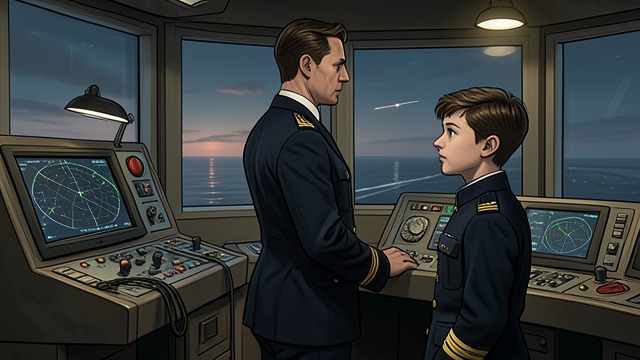
An Overeager Alarm
A small decision
While Keeling turns toward a reported contact, Carling prepares to sound General Quarters. George Krause refuses: one uncertain pursuit does not justify exhausting the whole crew’s battle reserve.
A judgment recorded
George Krause stores the incident as evidence about Carling’s judgment and readiness. The moment passes quickly, but it becomes part of how a commanding officer evaluates a subordinate.
Anxiety at the watch
Carling’s instinct may arise from concern rather than incompetence, but George Krause notices how responsibility affects him. The relationship begins in observation rather than open confrontation.
Confusion in the Night
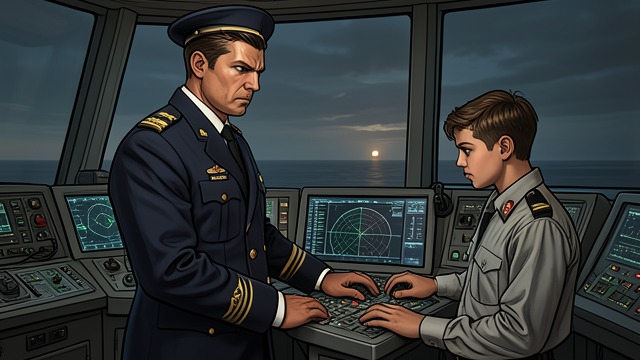
Confusion in the Night
A watch handed over
George Krause gives Carling the conn while he briefly leaves the bridge. When a radar contact appears, Carling keeps Keeling on a course that diverges from the submarine’s likely track.
A costly hesitation
George Krause returns and corrects the course, recognizing that Carling has not held the tactical picture clearly. Rather than treat the error as simple disobedience, he considers whether nerves have made Carling unable to think.
A measured response
The lapse strengthens George Krause’s doubts, but it also recalls his own early combat excitement. He continues to monitor Carling, leaving open the possibility that experience will improve his judgment.
A Test Passed
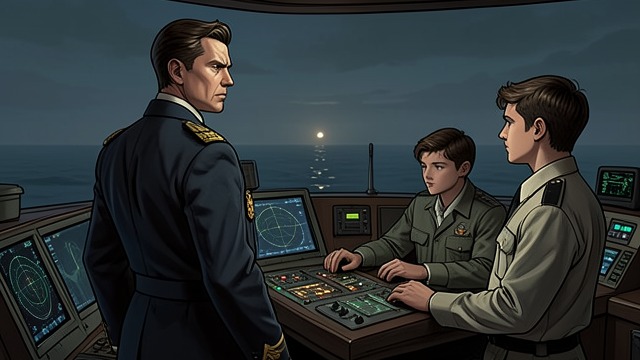
A Test Passed
Responsibility without prompting
Carling takes charge of routine decisions on the bridge, including a request to shift steering cables. George Krause lets him act within his authority instead of intervening automatically.
A simple course
When ordered to take Keeling back across the convoy’s front, Carling chooses and executes a suitable course promptly. George Krause sees that the assignment gives him a chance to recover confidence.
Training through command
George Krause’s restraint reflects his belief that command involves developing other officers, not merely correcting mistakes. Carling’s progress is modest, but it provides evidence that responsibility can teach what reprimand alone cannot.
Wednesday morning after James reports contact
Wednesday night after the pillenwerfer chase
Friday morning during convoy patrol
